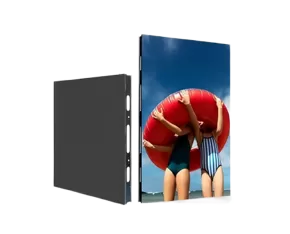
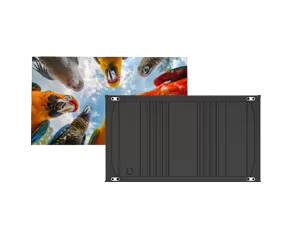
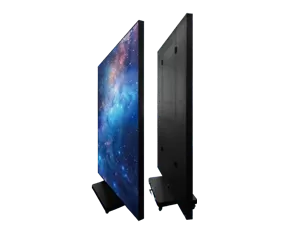
A tri-fold LED poster should be selected according to viewing distance, content format, installation space and deployment frequency—not pixel pitch alone. Compared with a conventional single-panel LED poster, the tri-fold structure offers a wider visual canvas and more flexible presentation modes, but it also requires additional planning for transport, setup and content design.
KMTEK's current Tri-Fold LED Poster Series is available in P1.538, P1.86, P2, P2.5 and P3.076 pixel pitches, giving buyers several options for different viewing distances and commercial environments.
A standard LED poster usually works as a single vertical digital advertising display. It is suitable for stores, showrooms, entrances and other locations where one portrait-format screen is enough.
A tri-fold LED poster adds multiple connected display sections that can be folded or expanded according to the available space. This creates three main advantages:
a wider visual canvas when fully expanded;
flexible folded and unfolded display modes;
more options for synchronized or multi-zone content.
However, tri-fold is not automatically better. If the screen will remain permanently in one location and only needs to display standard portrait advertising, a conventional LED poster may be simpler and more economical.
The tri-fold format becomes more useful when flexibility, stronger event visibility or multi-panel storytelling is required.
A trifold LED poster is particularly useful for exhibitions, retail launches, technology showrooms and temporary brand events.
At exhibitions, the expanded format can create a larger visual presence without requiring a permanently installed LED wall. Retail stores can use the additional display area to combine product video, promotional text and campaign graphics. Showrooms can also reposition the display when product layouts change.
Temporary brand activations are another strong use case because the screen can provide a more immersive presentation while remaining more flexible than a fixed video wall.
However, buyers should consider how often the unit will actually be moved. A tri-fold structure provides more display flexibility, but frequent transport also introduces practical requirements such as doorway clearance, loading, setup labor and protective transport cases.
KMTEK currently offers P1.538, P1.86, P2, P2.5 and P3.076 options for its Tri-Fold LED Poster Series.
A smaller pixel pitch is generally more useful when viewers stand close to the display or when the content includes small text, product details or high-resolution graphics.
A larger pitch may be sufficient when most viewers are several meters away and the display is mainly used for large promotional video.
| Content / Environment | What to Prioritize |
|---|---|
| Close-up product detail | Smaller pixel pitch |
| Text-heavy promotion | Higher pixel density |
| General video advertising | Balance pitch and cost |
| Longer viewing distance | Larger pitch may be sufficient |
| Premium showroom | Fine detail and visual consistency |
The smallest pitch should not automatically be treated as the best option.
A practical selection process is:
Viewing distance → content detail → screen dimensions → pixel pitch → budget
This approach helps avoid paying for pixel density that the audience may not actually notice.
One of the strongest advantages of a tri-fold LED poster is that the content can be designed around different display modes.
When fully expanded, the screen can operate as one continuous visual canvas. A product image or animation can extend across the complete display area, creating a stronger visual effect than three unrelated advertisements.
Another option is multi-zone content. The center area can display the main product or campaign video, while the side sections show specifications, prices or calls to action.
A center-focus layout can also work well for launches and exhibitions. The middle section carries the main visual, while both sides provide supporting information.
The important point is that the content should be planned around the physical screen format. Simply taking a standard vertical video and stretching it across a wider display may not make good use of the tri-fold structure.
For projects that frequently switch between folded and expanded operation, the content workflow should support both layouts.
A foldable display is not necessarily a lightweight display.
KMTEK lists the current Tri-Fold Series at approximately 83 kg ±1 kg, so buyers should consider the full deployment process rather than assuming it can be easily carried by one person.
For exhibition or event use, practical questions include whether the folded unit fits through doors and elevators, whether a flight case is required and how many people are needed for setup.
Transport frequency also matters. A display used permanently in one showroom has different requirements from a unit that travels to multiple events each month.
Power connection and content setup should also be considered. A screen that is easy to fold but difficult to commission at every venue may still create unnecessary deployment cost.
True portability therefore means:
transport + access + setup + power + content deployment
not simply cabinet weight.
Before requesting a quotation from an LED poster supplier, buyers should provide:
Project conditions: application, viewing distance, operating hours and deployment frequency.
Display requirements: preferred pixel pitch, folded/expanded use, content type and control requirements.
Logistics: doorway or elevator restrictions, transport method, quantity and local voltage.
It is also useful to explain whether the display will remain in one location or move regularly between exhibitions, retail stores and events.
This information allows the supplier to recommend the screen configuration based on real operating conditions rather than only screen dimensions.
A tri-fold LED poster is most valuable when a project needs an expandable visual canvas, flexible deployment and multi-panel content presentation.
If the requirement is simply a fixed vertical display playing standard advertising content, a conventional LED poster may already be sufficient.
If the project needs portable deployment, expanded presentation and more flexible visual storytelling, the tri-fold structure can offer greater value.
The buying decision should therefore begin with viewing distance, content strategy, installation space and deployment frequency—not pixel pitch alone.
It is a foldable multi-panel LED display that supports both compact and expanded presentation formats.
A standard poster normally uses one vertical display area, while a tri-fold poster provides a wider and more flexible visual canvas.
It depends on viewing distance, content detail, screen size and budget.
Yes, when the content and control system are configured for a continuous expanded display.
Provide the application, viewing distance, content requirements, deployment frequency, transport restrictions, quantity and local power requirements.

I’m Engineer Liang, a LED display specialist with 20 years of hands-on experience. My work spans panel assembly, system integration, and performance optimization across various product lines.
I’ve provided on-site after-sales support in over 30 countries, It solves problems such as pixel failure and signal instability in large installation projects ranging from commercial billboards to stadium screens.These trips honed my ability to adapt solutions to local environmental conditions.
Remotely, I have remotely assisted hundreds of customers with display calibration, software debugging and diagnostic, and operational guidance, including fine-tuning color uniformity on LED screens and resolving connectivity issues with control systems etc.
I focus on practical problem-solving, ensuring timely, effective support to minimize display failure, protect the interests of customers.Keeping pace with LED tech advancements, I aim to deliver reliable expertise to clients worldwide.